


Easterseals Podcast Ep. 7: Play with Purpose
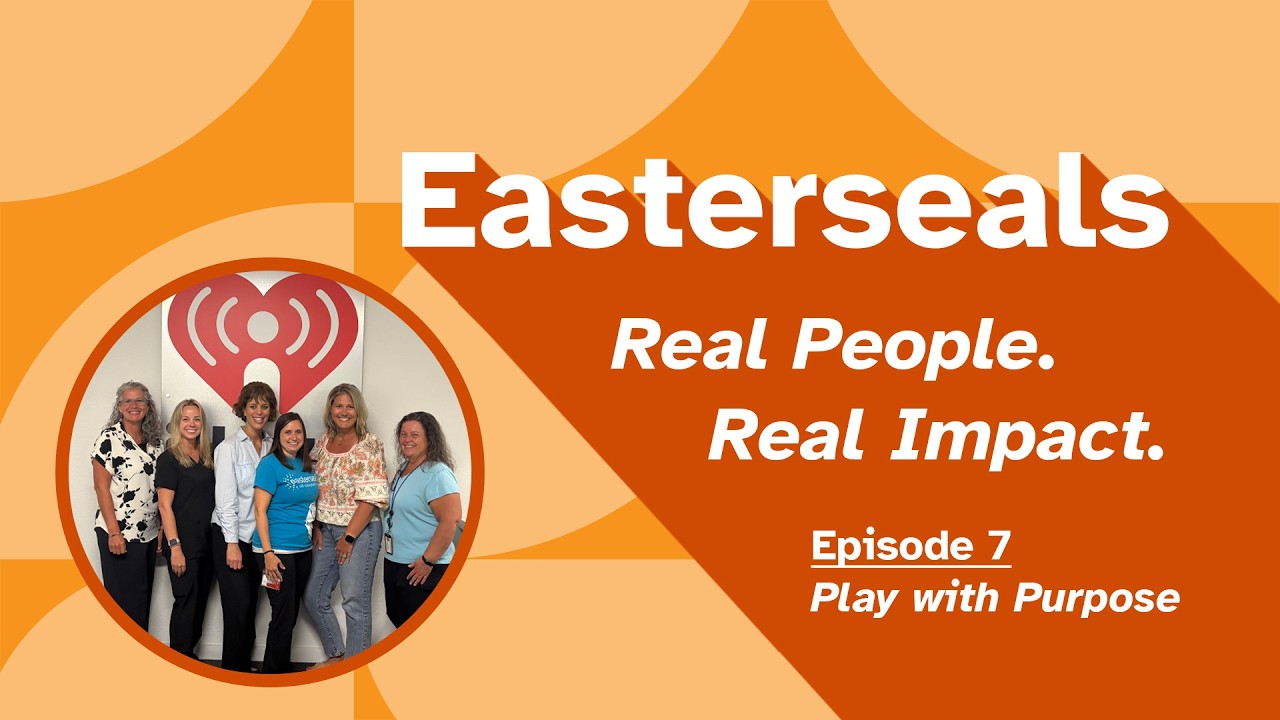
Produced in partnership with Easterseals and iHeartRadio’s 94.7 WDSD, "Easterseals: Real People. Real Impact." is a podcast series focused on raising awareness about the life-changing services Easterseals provides.
Real People, Real Impact | Episode 7: Play With Purpose
In this episode of Easterseals: Real People, Real Impact, Christy Cooper sits down with Jackie McDonough, an early childhood educator at Easterseals, to explore the power of play and how it helps young children learn, grow, and build confidence. With nearly 38 years of experience, Jackie shares how play-based learning supports children's development, what families can expect during early intervention sessions, and how parents and caregivers can help their children reach important developmental milestones through everyday activities.
Q: What is an early childhood educator?
Christy Cooper: Today, we're diving into pretty much what you do each and every day. We're going to talk about what an early childhood educator does, how play becomes a powerful teaching tool, and why every therapy session is designed around each child's unique strengths and needs.
How long have you been doing this?
Jackie McDonough: September 2026 will be 38 years.
Christy: Good for you! That's amazing. You must love what you do.
Jackie: I do. I love my toddlers!
Christy: So, Jackie, what is an ECE?
Jackie: An ECE is just an early childhood educator. Other people call me a developmental specialist, whatever, but basically, I am the teacher. I am the teacher of children under the age of three.
Christy: And so, what kind of development do you focus on?
Jackie: It depends on the situation. Every child is different and unique. If they have multiple services, such as occupational therapy, physical therapy, or speech therapy, we do a coaching model. My goals would be cognitive and social-emotional development.
If I'm by myself, I work on everything, because teachers do everything! It's one of those things where you look at the situation you're in and work with the families to decide what their concerns are, what things in development they're concerned about, and what they want to work on. So it is a family affair, right?

Q: How does play help children learn and grow?
Christy: The parents or caregivers certainly have to be involved in that process. And are the kids playing with toys? Is this primarily the age range where they're playing, but they're also learning?
Jackie: Yes! Play-based learning is amazing. Children learn by touching, seeing, manipulating things, and just playing.
We, as teachers, show the parents, child care providers, guardians, or whoever is in charge of that child different ways to play. We show them how to model functional play so that they're using a toy the appropriate way.
Some children don't have the ability to actually manipulate toys, so we help them in different ways. If they're lying down, we might hold things above them so they can see them, or we can do different sensory activities, like putting something in their hands and letting them squeeze it.
Everybody is different. It's not just one set way. It's based on that child and the family and what they want to see happen for their child's growth.
Christy: So every child really gets an individualized experience?
Jackie: Yes, everyone. It's true. It is individualized because not one child is exactly the same as another. And the families are the first teachers.
They need to be the ones to carry through what we are showing them to do. It is not my job to go in and fix anything. It is to show them and model things so that they can continue this throughout their life.
Christy: Absolutely, because you're working with the little ones and you're starting there for their growth and their future.
Q: What does a typical early intervention session look like?
Christy: What does a typical session look like? I know we talked a lot about the toys and the ways that you can modify those for their needs, but what does that session look like for a parent who might be wondering if their child is a fit for this?
Jackie: Most sessions, I go in and recognize who the child is and say, okay, what are their abilities? We've already created goals with the family and decided, okay, this is what our plan is.
I'll go in and use whatever toys or materials they have in their home. I do not bring anything in, and the reason being is if I bring something in and then I have to take it home, they can't practice that.
So we use what they have in the home. I also provide different ideas for families to create their own toys, which really helps. Simple things, like an empty cereal box stuffed with some paper and taped up. There's your blocks! You can make blocks with simple things, so I work on that as well with them.
Christy: That's awesome. I didn't even think about that.
But seriously, it makes sense. I didn't realize you're actually going to these homes. They're not necessarily coming to Easterseals, right?
Jackie: We either go to their home, we go to a child care center or a family daycare, or they come into Easterseals.
Christy: And how long are these sessions?
Jackie: They're about 60 minutes each, once a week, generally. We kind of start off with what has happened through the week with the family. Have they done any new things? New skills? Have they made any new sounds? How was their weekend?
It just makes it more of a family-friendly type of situation. Then we'll say, okay, what should we work on today?
Sometimes I'll ask the week before and say, "Hey, next week we can work on puzzles, or we can work on picking up toys with one hand," or things like that. So we discuss it ahead of time so that the families know what we're going to do.
Christy: Absolutely. And that's why the family and the caregiver play such a big role in the plan and the progress, right? To watch these children grow and continue to learn.
Q: Can you share a special moment or success story?
Christy: Jackie, can you tell me about a moment of a child's growth or a favorite memory of working with a child that you can share? Or multiple?
Jackie: I have multiple! I have multiple. I could go on all day.
Just yesterday, I had a child in a classroom at a child care center. He had not functionally played with any toy since I started working with him about two or three months ago.
I sat down and pulled out a puzzle, just trying something new, and I took three pieces out.
He looked at me, and he doesn't speak, so he just looked at me and put the three pieces in. He did it! It was amazing. I had tears coming down, and the teacher in the classroom said, "Did he just do that?"
And I said, "Yes, he did, and he did it on his own!" I didn't tell him to put them in. He just picked them up and put them back in place.
Then I did it again with three different pieces, and he did that, too.
I had goosebumps by the end of the day. I called the parents as soon as the session was over and said, "This was amazing!" I encouraged them to try to do this at home.
Christy: Absolutely! Well, what you've been doing and working with him on is starting to show that progress and growth.
Jackie: It was absolutely amazing. And the smile on his face! He was like, "Oh, you did it!" Of course, I get a little excited and I was clapping. Then the teachers were clapping, and his little friends were clapping. It was great!
It was a moment that I wish families could see, but they have to work and things like that. I shared it with them, wrote it in his journal, and I just think that everybody needs to do that. Then the teachers learn something, too, like, "Oh, we'll continue with that and keep going."
So it was kind of an all-around great day.
Christy: And I'm sure you've got a lot of stories like that. It really goes to show how this program and what you do really does help these children grow, especially at such a young age.
Q: How can families access early intervention services?
Christy: Let's talk about what someone needs to do. If they're listening right now and realizing they want more information on getting their child involved, or even finding out if this is right for their child, what's the first step and what do they need to know?
Jackie: First of all, you can contact Easterseals. They have a wealth of resources that can guide you and help you through that process.
Or you can go online and look for Birth to Three, or call them, and they will help you figure out what your family will need.
Christy: Jackie, thank you so much for sharing your experience and giving us a better understanding of the important role early childhood educators play in helping children and families thrive together.
If you'd like to learn more about Easterseals Early Intervention Services or Delaware's Birth to Three program, you can reach out to Easterseals Delaware & Maryland's Eastern Shore online at EastersealsDEMD.org.
Jackie, thank you so much for joining me today!
Jackie: Thank you for having me!
Christy: Keep it up with those kids!
Jackie: I will!

Use this link to browse the Resource Library at Easterseals Delaware & Maryland's Eastern Shore.
Sign up for Emails from Easterseals
Get exciting news, helpful resources, & inspiring stories delivered to your inbox each month.